
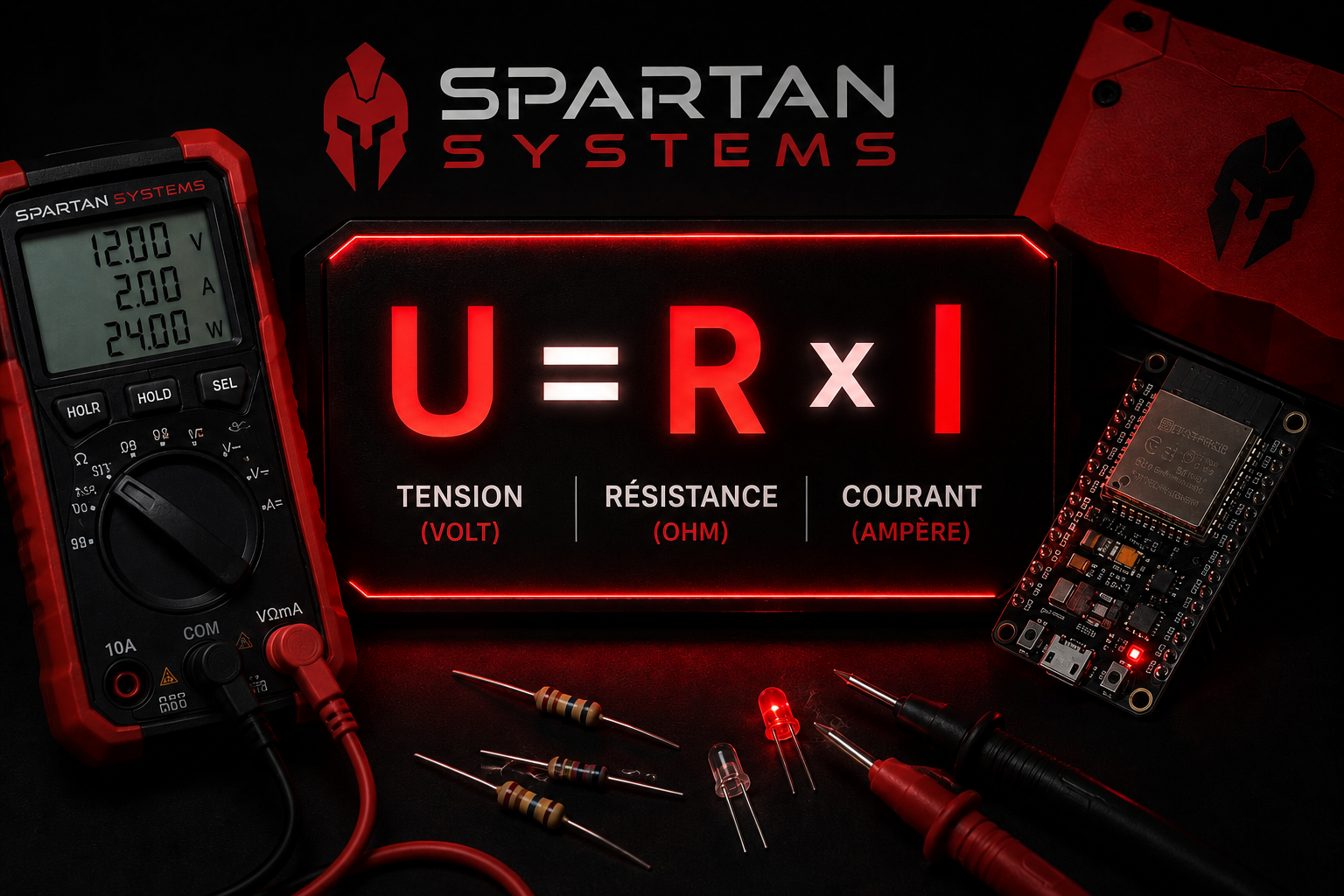
When you start working with Arduinos, ESP32s, drones, or any electronic system, there is one formula you will find absolutely everywhere: Ohm’s Law.
It is probably the first concept every maker, electronics enthusiast, or engineer learns. Yet many people use it without truly understanding what it represents.
In this article, we will simply explain what Ohm’s Law is, how to use it, and why it is essential in every electronics project.
What is Ohm’s Law?
Ohm’s Law describes the relationship between:
- voltage (Volt)
- current (Ampere)
- resistance (Ohm)
It is generally written as:
U = R × Iwhere:
- U : voltage in Volts (V)
- R : resistance in Ohms (Ω)
- I : current in Amperes (A)
This formula simply states that voltage equals resistance multiplied by current.
A simple analogy: the water pipe
To intuitively understand Ohm’s Law, imagine a water pipe.
- Voltage represents the water pressure.
- Current represents the flow rate.
- Resistance represents the pipe diameter or a constriction.
The higher the pressure, the greater the flow.
Conversely, the narrower the pipe, the harder it is to push water through.
Electricity behaves in a very similar way.
The three formulas to know
From the main formula, we can derive the other two:
Calculating current
I = U / RCalculating resistance
R = U / IThese three equations solve the majority of basic electronics problems.
Practical example with an LED
Let’s say we want to power an LED from a 5V supply.
The LED requires approximately:
- LED forward voltage: 2V
- desired current: 20 mA (0.02 A)
The resistor must absorb:
5V - 2V = 3VWe can then calculate its value:
R = 3 / 0.02 = 150 ΩWe will therefore use a 150 Ohm resistor to protect the LED.
Why does it matter?
A poor understanding of this law can quickly lead to:
- burnt-out components
- overheating
- batteries draining too fast
- unstable systems
Electrical power
Ohm’s Law is often used alongside the power formula:
P = U × Iwhere:
- P = power (Watts)
- U = voltage (Volts)
- I = current (Amperes)
This formula lets you calculate, for example, the power consumption of a motor, a computer, or a drone.
Conclusion
Ohm’s Law is simple to remember but extremely powerful.
It explains how voltage, current, and resistance interact in an electrical circuit.
Before designing a drone, a robot, an embedded system, or even a simple ESP32 project, taking a few minutes to check your calculations with Ohm’s Law can prevent many mistakes.
It is one of those fundamental pieces of knowledge that will stay with every maker, electronics enthusiast, or engineer throughout their career.